

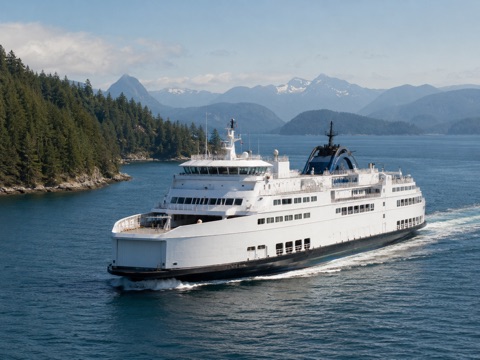
For people who live on the Sunshine Coast, the ferry is not a novelty. It is not just part of a summer getaway or a scenic start to a weekend away. It is the road home.
That is why disruptions on the Horseshoe Bay to Langdale route hit differently here. When sailings are delayed, cancelled, or suddenly restricted, the impact is immediate. Residents miss appointments. Workers lose time. Families rearrange plans. Visitors arrive stressed before their holiday has even begun. Local businesses feel it too, especially in summer, when the Coast depends on people being able to move with some degree of predictability.
The current issue is tied to a mechanical problem with Berth 1 at the Langdale terminal. Because of that, BC Ferries has had to restrict vehicle loading to the main deck only through Berth 2, reducing the number of vehicles that can be carried on each sailing. For now, vehicle travel on the Horseshoe Bay-Langdale route is by advance booking only, with reduced capacity causing understandable frustration on both sides of the crossing.
And while the situation may be temporary, the reaction is not really about one mechanical failure. It speaks to something much bigger.
The Coast depends on one key link.
The Sunshine Coast is deeply connected to the Lower Mainland, but it is also vulnerable to the limits of one key transportation link. When the ferry system works, it can feel seamless. When it does not, the geography of the Coast becomes very real, very quickly.
This is especially true in the summer. The same route has to serve local residents, tradespeople, medical travel, commuters, delivery vehicles, tourists, cyclists, foot passengers, and people heading to cabins or campgrounds. There is very little slack in the system. A berth problem, a vessel issue, a staffing challenge, or a weather delay can ripple through the day and create a level of disruption that feels far larger than the original cause.
Plan carefully if you are coming over.
For visitors, the message is simple: plan ahead, book early, check BC Ferries updates before leaving, and do not assume there will be space for drive-up traffic. Travelling as a foot passenger may be easier in some cases, but even then, parking and terminal congestion can become part of the equation.
For residents, it is another reminder of how essential ferry reliability is to daily life on the Coast. This is not just a transportation inconvenience. It affects access to health care, work, school, family obligations, construction schedules, small businesses, and the overall rhythm of the community.
Beautiful, connected, and dependent on infrastructure.
The Sunshine Coast remains one of the most beautiful and desirable places in British Columbia. Its appeal is obvious: ocean, forest, small communities, slower pace, and a sense of separation from the city. But that separation depends on infrastructure that has to be maintained, modernized, and treated as essential.
Ferry disruptions are frustrating, but they are also instructive. They show how much the Coast depends on a system that many people only notice when it stops working smoothly.
For now, anyone travelling between Vancouver and the Sunshine Coast should treat the ferry as something to plan around carefully, not casually. Check the current conditions, make a reservation, allow extra time, and be patient with the people working at the terminals. They are managing a difficult situation in the middle of peak travel season.
The larger point is harder to ignore: coastal communities need reliable coastal infrastructure. On the Sunshine Coast, the ferry is not just transportation. It is the connection that makes everyday life possible.